
NOTE
1.31 InnoDB redo log
1. What Is redo log - A log of the MySQL InnoDB storage engine, used for crash recovery - redo log is a disk-based data structure used during crash recovery to correct data written by incomplete transactions 2. Why redo log Is Needed - According to durability requirements, once a transaction commit completes, it must be persisted to disk. There are two approaches
This is a historical learning note and may contain outdated or incomplete understanding.
1. What Is redo log
- A log of the MySQL InnoDB storage engine, used for crash recovery.
- redo log is a disk-based data structure used during crash recovery to correct data written by incomplete transactions.
2. Why redo log Is Needed
- According to durability requirements, once a transaction
commitcompletes, it must be persisted to disk. There are two approaches:- One is to flush all pages modified by the transaction to disk before the transaction commit completes. However, this approach has very poor performance.
- The other is logging: just record which parts of which pages were modified, and write this log to disk before commit completes. The amount of log data is very small and the I/O is sequential.
3. WAL
- Write-Ahead Logging: write the log first, then write to disk.
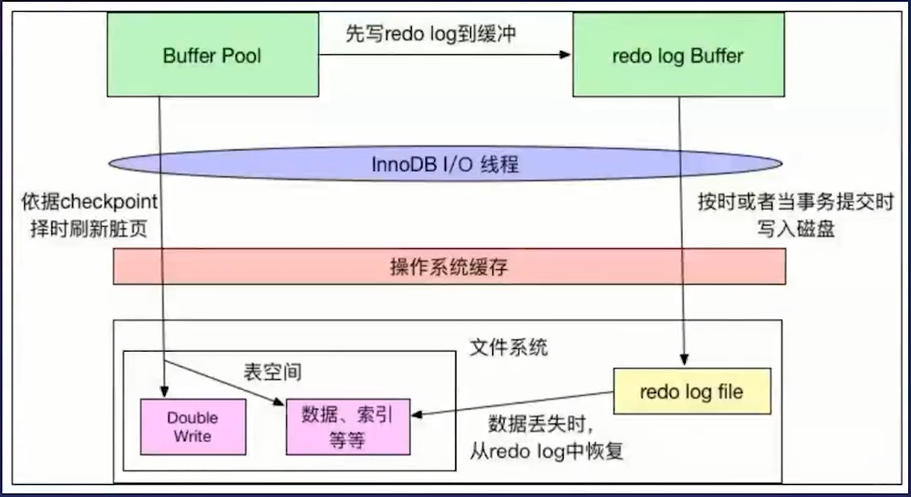
- redo log consists of two parts: an in-memory log buffer (
redo log buffer) and an on-disk log file (redo log). - When the server starts, it requests a large contiguous memory space from the operating system called the redo log buffer.
- Every time MySQL executes a DML statement, it first appends the record to the redo log buffer.
- At certain times the log buffer is flushed to disk:
- when log buffer space is insufficient;
- when a transaction commits;
- when a background thread flushes once per second;
- when the server shuts down normally;
- at a checkpoint.
4. Log Format
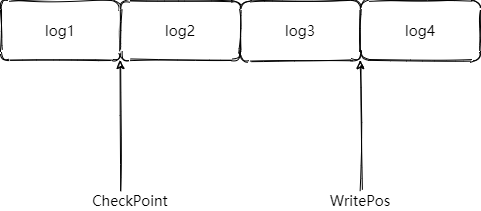
- A circular array is used underneath.
WritePos -> CheckPointis free space;CheckPoint -> WritePosis data that has not yet been flushed to disk.
5. redo log Write Mechanism
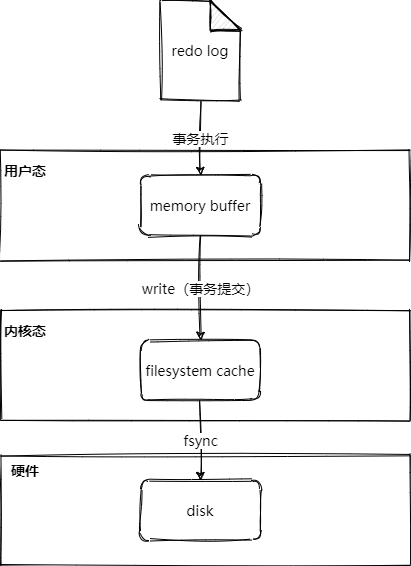
- During transaction execution, generated redo log is first written to the redo log buffer.
innodb_flush_log_at_trx_commitparameter:- when set to
0, every transaction commit only leaves the redo log in the redo log buffer; - when set to
1, every transaction commit directly persists the redo log to disk; - when set to
2, every transaction commit only writes the redo log to the page cache.
- when set to
- Background thread:
- performs
write + fsyncevery 1 second; - when the space occupied by the redo log buffer is about to reach half of
innodb_log_buffer_size, the background thread proactively writes to disk.
- performs
- Group commit:
- assign an LSN to each redo-log; redo-logs from multiple concurrent transactions are fsynced together, and the bin-log can also be fsynced together.
6. redo-log vs bin-log
| redo-log | bin-log | |
|---|---|---|
| Layer | Storage-engine layer, specific to InnoDB | Server layer, usable by all engines |
| Log format | Physical log; records “what modification was made on a certain data page.” See Distributed System Replication.md | Logical log; records the original logic of the statement, for example “increment column c by 1 for the row with ID=2.” See Distributed System Replication.md |
| Write method | Circular writing. The space is fixed and will be reused when full | Append writing. When a binlog file reaches a certain size, it switches to the next file and does not overwrite previous logs |
7. How to Keep redo-log and bin-log Consistent
7.1. Two-Phase Commit
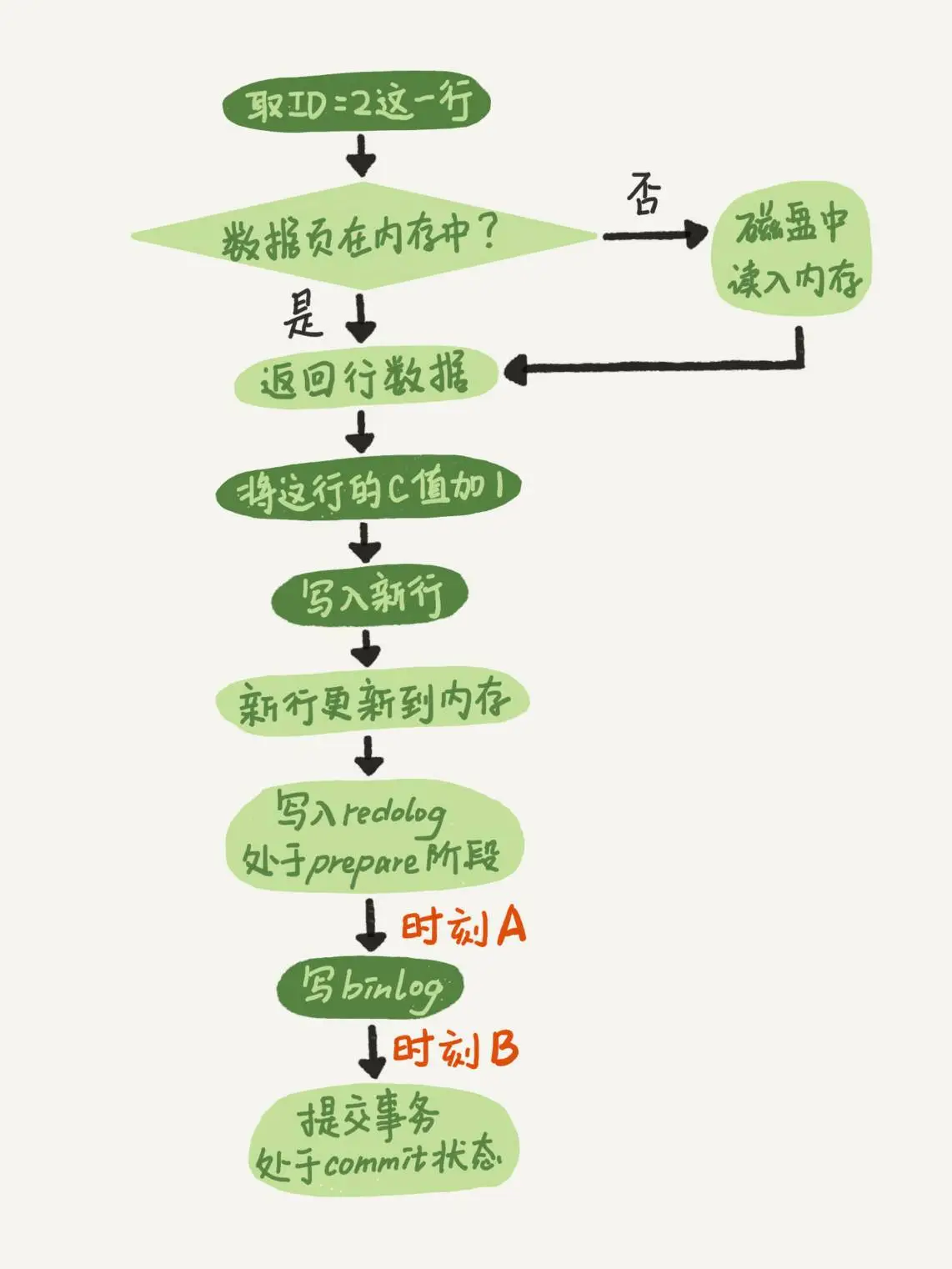
- Write the redo-log; it is in the
preparestate. - Write the bin-log.
- Commit the transaction; the redo-log enters the
commitstate.
The following explanations assume the data is in memory:
If MySQL crashes at time A, after restart and crash recovery it finds that the redo-log is in the prepare state and the bin-log has not been written, so it rolls back directly.
If MySQL crashes at time B, after restart and crash recovery it finds that the redo-log is in the prepare state and the bin-log has already been written. The integrity of the bin-log needs to be checked; if it is complete, the transaction is committed directly.
If MySQL crashes at time C, after restart and crash recovery it finds that the redo-log is in the commit state, which means the redo-log and bin-log are complete, so it commits directly.
Discussion
Sign in with GitHub to comment. Discussions are stored as GitHub Issues.View on GitHub